How to Make the Case for a Car Service at Work

The strongest case for a workplace car service is a business case, not a request for a perk. If you’re working out how to convince your boss that your team needs a car service, link the proposal to a clear work problem, support it with evidence, and present it in a format your boss prefers. That keeps the discussion focused on the decision and its business purpose.
Your manager may ask what the current arrangement costs in time, coordination, or disruption, and whether a different approach would help. A convincing pitch addresses those concerns and recognizes that a chauffeur service may not be the right fit for every trip or team.
This guide explains how to build a credible proposal for a Dubai or UAE workplace, from gathering practical examples and choosing useful measures to deciding whether a pilot makes sense. It also shows how to tailor your presentation to your boss, whether they prefer a concise written case, a conversation, or a small-scale test. The goal is a clear, balanced request your manager can assess.
Key Takeaways
- Frame the request around a workplace problem and the outcomes your manager prioritizes.
- Use clear examples of travel time, coordination, and disruption to make the case easier to assess.
- Build trust by involving colleagues and defining how a small-scale trial would be evaluated.
- Choose a pitch format that suits your boss, from a concise written proposal to a focused conversation.
- Match the transport arrangement to the trip, with airport transfers or chauffeur services for business travel needs.
Table of Contents
What is the best way to convince the boss?
Tie the request to a defined business need, then make it easy to assess. A concise proposal should explain who benefits, which trips qualify, and how you’ll measure the result.
Decision-Maker Goals and Access
Start with an outcome your manager is responsible for, such as punctual client meetings or smoother travel between offices. Give a concrete example: a team loses preparation time coordinating separate journeys before an important meeting. Then explain how a shared transport arrangement could address that problem.
Identify the decision-makers before you present. A department manager may sponsor the request, while finance reviews spending and HR considers eligibility or policy. In a smaller business, the managing director may handle several roles. Ask your manager who should be involved, then arrange a focused call with a short agenda and written summary.
To work out how to convince your boss that you need a car service, gather evidence instead of making broad claims. Record trip purpose, travel time, delays, booking effort, and the roles of the employees travelling. Compare the current process with the proposed one, and keep the request tied to business priorities rather than personal preference.
Business Problems and Service Options
Describe the problem in operational terms: missed connections, fragmented bookings, late arrivals, or employees using personal vehicles for work. Estimate demand by reviewing upcoming travel plans and past trip records. Propose consistent eligibility rules based on business purpose, destination, role, or client-facing duties.
UAE company transport can include point-to-point journeys, airport transfers, hourly or full-day chauffeur bookings, and event transport. Choose the format to fit the trip pattern: a direct journey differs from a schedule with several stops. State which employees and journeys qualify.
Employers should consider driver authorization, vehicle insurance, passenger safety, reliability, and liability. UAE requirements depend on the transport arrangement and applicable jurisdiction, so have internal compliance staff review operating permissions and coverage before approval. Don’t assume an employee’s personal vehicle policy covers hired business transport.
Test the idea with a limited pilot. Before it begins, define success measures such as punctual arrivals, time spent coordinating bookings, employee uptake, and reported issues. At the end, compare those measures with the existing process.
Transportation and Reimbursement Comparisons
Compare a corporate car service with taxis, ride-hailing, and mileage reimbursement using the same sample journeys. Taxis and ride-hailing can suit individual trips, while a planned service can centralize bookings or support a multi-stop schedule. Reimbursement uses employees’ own vehicles, so include mileage records and the administrative work involved.
There’s no universal winner: trip frequency, scheduling needs, passenger numbers, and internal controls determine what fits. Give finance a like-for-like comparison that includes journey purpose, waiting requirements, receipts, and coordination tasks. Don’t claim savings unless your figures support them.
Close by requesting a decision, not an open-ended endorsement. Ask whether your manager supports a defined pilot, who needs to approve it, and when to review the results. A clear next step makes the proposal easier to evaluate.
Build credibility and trust
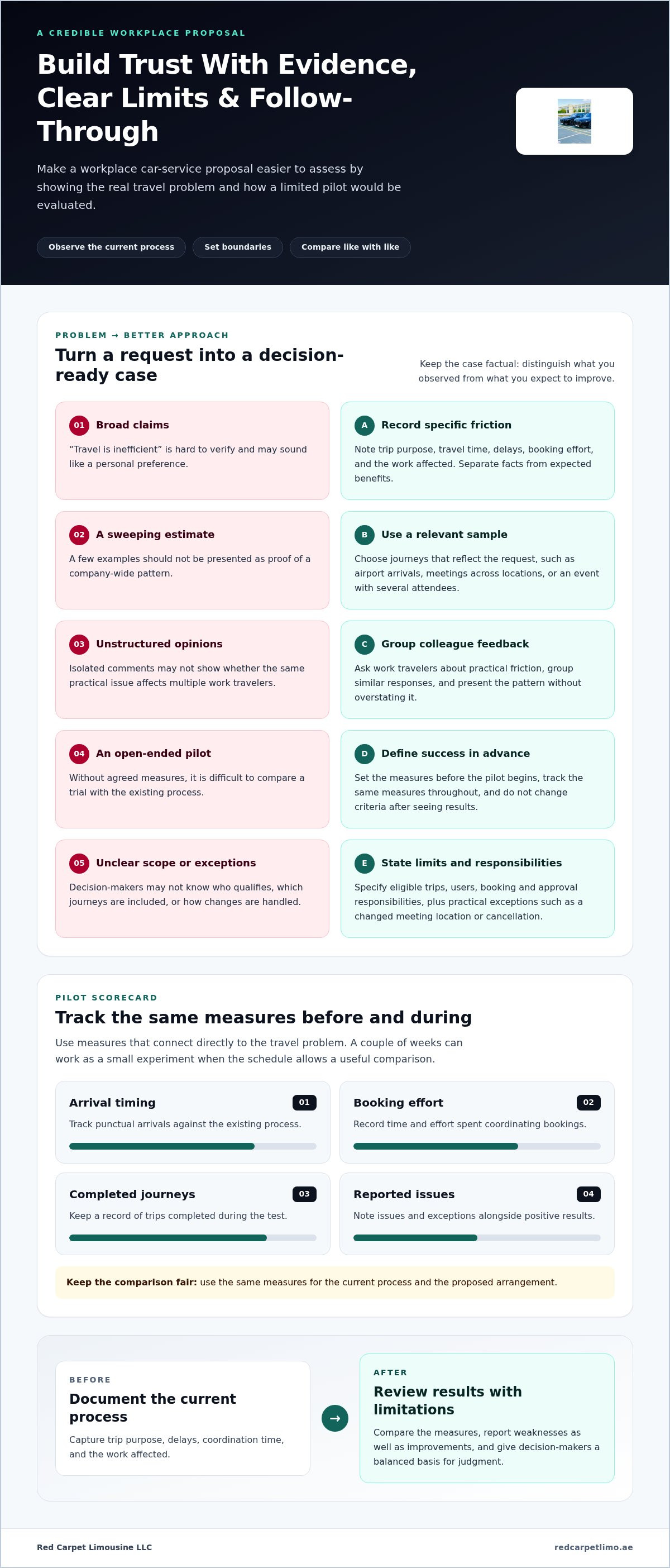
A persuasive proposal builds trust through evidence, clear limits, and follow-through. Before presenting it, document the transport problem, including trip purpose, booking steps, delays, coordination time, and the work affected. For example, note when employees arrange separate journeys before a client meeting or a manager loses preparation time coordinating several pickups.
Keep the evidence factual. Separate what you observed from what you expect a new arrangement to improve. If the team spends time comparing options, record the task and who handles it. Don’t claim a service will save time unless your comparison supports that. A balanced case also acknowledges where the current method works well.
Use a small, relevant sample of journeys rather than a sweeping estimate. Choose examples that reflect the request, such as airport arrivals, meetings across different locations, or an event with several attendees. Remove personal details that aren’t needed for the business case. A concise summary helps finance and management understand the issue without exposing unnecessary travel information.
Colleague input can show whether the problem affects more than one person. Ask employees who travel for work to describe practical friction points, then group similar responses. Several employees might, for example, report spending time coordinating separate bookings. Present the pattern without turning a few comments into a company-wide statistic. Ask colleagues whether the proposed process would address those specific issues.
A pilot can add evidence if its purpose is clear. Define success before it starts, then track the same measures you used to describe the current process. A couple of weeks can work as a small experiment when the travel schedule allows a useful comparison. Record completed journeys, arrival timing, booking effort, and reported issues. Don’t change the success criteria after seeing the results.
Trust also depends on explaining limitations. State which trips the proposal covers, who can use the service, and who handles booking and approval. Note practical exceptions, such as a changed meeting location or a cancelled journey. If the pilot exposes a weakness, report it alongside positive results. This gives decision-makers a fuller basis for their judgment.
Close with a concise evidence pack: the current process, selected examples, colleague feedback, proposed boundaries, and pilot measures. Label estimates clearly and show how you reached them. Ask a colleague to review the figures and wording before sharing them with management. That review can catch unclear assumptions and keep the proposal professional.
Choose a pitch format suited to the boss
The same proposal can work differently as a conversation, email, or short presentation. Choose the format your manager already uses to make decisions. If they review concise emails, send a focused written case. If they prefer discussion, request time on an existing team agenda. Match the presentation to their working style, not your personal preference.
For a finance-focused manager, use a one-page comparison. Put the current travel process beside the proposed arrangement. Include trip types, booking steps, approval process, and the measures you’ll track. Separate verified observations from expected benefits so finance can see the assumptions without sorting through a long narrative.
A manager who values operational detail may prefer a short slide deck. Use one slide to describe the travel problem, another to explain the proposed approach, and a final slide for the pilot plan. For example, show how a visiting team coordinates separate journeys between an airport and a meeting, then outline how one booking could simplify that itinerary.
For a relationship-focused boss, a brief conversation may be the best opening. Start with a work example, such as a client meeting affected by fragmented travel arrangements. Explain the proposed change plainly, then invite questions. Bring a written summary so the discussion ends with clear next steps rather than relying on memory.
Some managers want the conclusion first. Lead with the decision you’re requesting, then give the reason and supporting detail. Others prefer context before a recommendation. In that case, describe the current process, explain its effect, and present the proposal last. Consider how your manager handled the previous travel or scheduling request.
Make every format easy to scan. Use descriptive labels such as “Current process,” “Proposed change,” and “How we’ll assess it.” Avoid decorative charts that don’t clarify a decision. If you include a table, use the same journey examples in each column. Readers should be able to compare options without decoding unfamiliar terms.
Prepare for likely questions in the format you choose. A written proposal can include a short response beside each concern. In a live meeting, be ready to explain who handles booking, which journeys qualify, and how exceptions work. If your boss asks about another scenario, answer directly and note it for follow-up.
End with a specific decision request. Ask whether your manager supports developing a pilot, wants finance involved, or needs a revised proposal. In an email, make that request the final sentence. In a meeting, repeat the agreed next step before leaving. This gives the conversation a clear outcome and makes responsibility visible.
What business problems can a company car service solve?
A company car service can address specific travel friction, not every workplace transport need. In the UAE, identify where staff travel affects schedules, client commitments, or coordination. For example, a team visiting several offices may lose working time arranging separate journeys. Describe the operational problem before recommending a transport arrangement.
Fragmented bookings are one clear issue. If employees arrange separate rides for the same meeting, an administrator may have to coordinate multiple pickup details and receipts. A planned journey can centralize those arrangements. Compare the current and proposed processes by noting who books, who approves, and who handles follow-up.
Travel between locations can also interrupt employees’ working time. Consider a manager travelling from a Dubai office to a client meeting elsewhere in the city. Ask whether driving, parking, or coordinating transport distracts from preparation. Map the whole itinerary, including stops and meeting times, before proposing a service.
Client-facing journeys raise a different consideration: consistency. For a scheduled visit, a defined transport plan gives the host one arrangement to communicate instead of separate instructions for each guest. This may help with meetings, visiting colleagues, or corporate events—similar to how international teams coordinate with destination management providers like BELUNE for structured group travel across Europe. Set out who greets passengers, shares journey details, and handles changes internally.
Mileage reimbursement may suit occasional trips, while frequent travel can create repeated recordkeeping. Compare the administrative steps, not just the journey. Note how employees submit mileage, how managers review claims, and how finance processes them. A company-arranged journey may be worth assessing when those tasks recur or personal vehicles complicate planning.
Choose the service format around the actual itinerary:
- Point-to-point travel: one pickup and a defined destination, such as an office-to-client meeting.
- Hourly arrangements: useful to assess when a work schedule includes several stops.
- Full-day arrangements: consider for a day planned around multiple business appointments.
These formats suit different travel patterns, and none automatically fits every employee. Define eligibility by business purpose, approved destinations, and scheduling needs. Then assess a typical work period using booking effort, arrival timing, trip changes, and employee feedback. Keep the measures consistent with the current process so managers can compare like with like.
For a practical next step, explore business travel arrangements that align with the journeys your team needs to manage.
A workplace proposal may be more persuasive when it connects to your boss’s goals or a problem they need solved. The article says there is a strong case for access to a leased company car when an employee drives more than 10,000 business miles per year. Support the case with data comparing time spent on current tasks with time a new tool could save.
Red Carpet Limousine: Airport Transfers (DXB & AUH)
Red Carpet Limousine provides airport transfers at DXB and AUH for business travel. They can suit visiting colleagues or executives who need a planned journey from the airport, or an itinerary that requires onward transport between locations.
For a single destination, Point-to-Point Transfers suit a defined route. Hourly Chauffeur Service or Full Day Chauffeur Service may better fit schedules with several business stops. When proposing a service internally, connect the option to the itinerary, from airport arrival to meeting locations and onward travel.
Share the relevant journey details with your decision-makers and consider which arrangement fits the trip. To discuss business travel transportation, contact Red Carpet Limousine or visit redcarpetlimo.ae.
Make the Next Step Clear
A workplace transport proposal can open a broader discussion about how your team plans business travel. Use it to agree on the problem worth addressing, who is responsible for the decision, and what evidence they need. If you’re still considering how to convince your boss that your team needs a car service, focus on a practical next step rather than asking for an immediate, open-ended commitment.
For example, suggest reviewing a specific upcoming journey together and deciding whether a different arrangement would better suit its schedule. That keeps the conversation grounded in real work and gives your manager room to assess the request. If your next step involves arranging business travel, contact Red Carpet Limousine LLC to discuss the journey. A clear, considered proposal puts you in a strong position to move the discussion forward.
Frequently Asked Questions
How do you calculate the cost and ROI of a corporate car service?
Compare the full transport expense with the value of the work it supports. Build a spreadsheet with trip frequency, journey type, employee time spent coordinating travel, reimbursement administration, and the quoted service amount. The amount depends on vehicle class, route, duration, and trip requirements, and is provided after a quote request. Estimate ROI by comparing measurable gains with total costs, and label assumptions clearly.
How do you prepare a proposal and pitch a car service to your boss?
Prepare a short decision document that names the business need, proposed arrangement, and approval you’re seeking. Add a sample itinerary, such as an airport arrival followed by an office meeting, to show how the request applies in practice. Include the budget owner and a proposed review date. Close with a direct choice, such as approving a defined test or asking for a revised plan.

Disclaimer
The information provided on this website is for general informational purposes only. While Red Carpet Limousine LLC strives to keep all content accurate and up to date, vehicle availability, pricing, offers, and service details may change without notice. Images shown are for illustrative purposes only and actual vehicles may vary. For the latest information and confirmed bookings, please contact Red Carpet Limousine LLC directly.